✦ Practical ideas for Android, Kotlin, and AI builders.
Why Every Mobile Engineer Must Learn AI

If someone asked you to learn AI today, what would you actually learn?
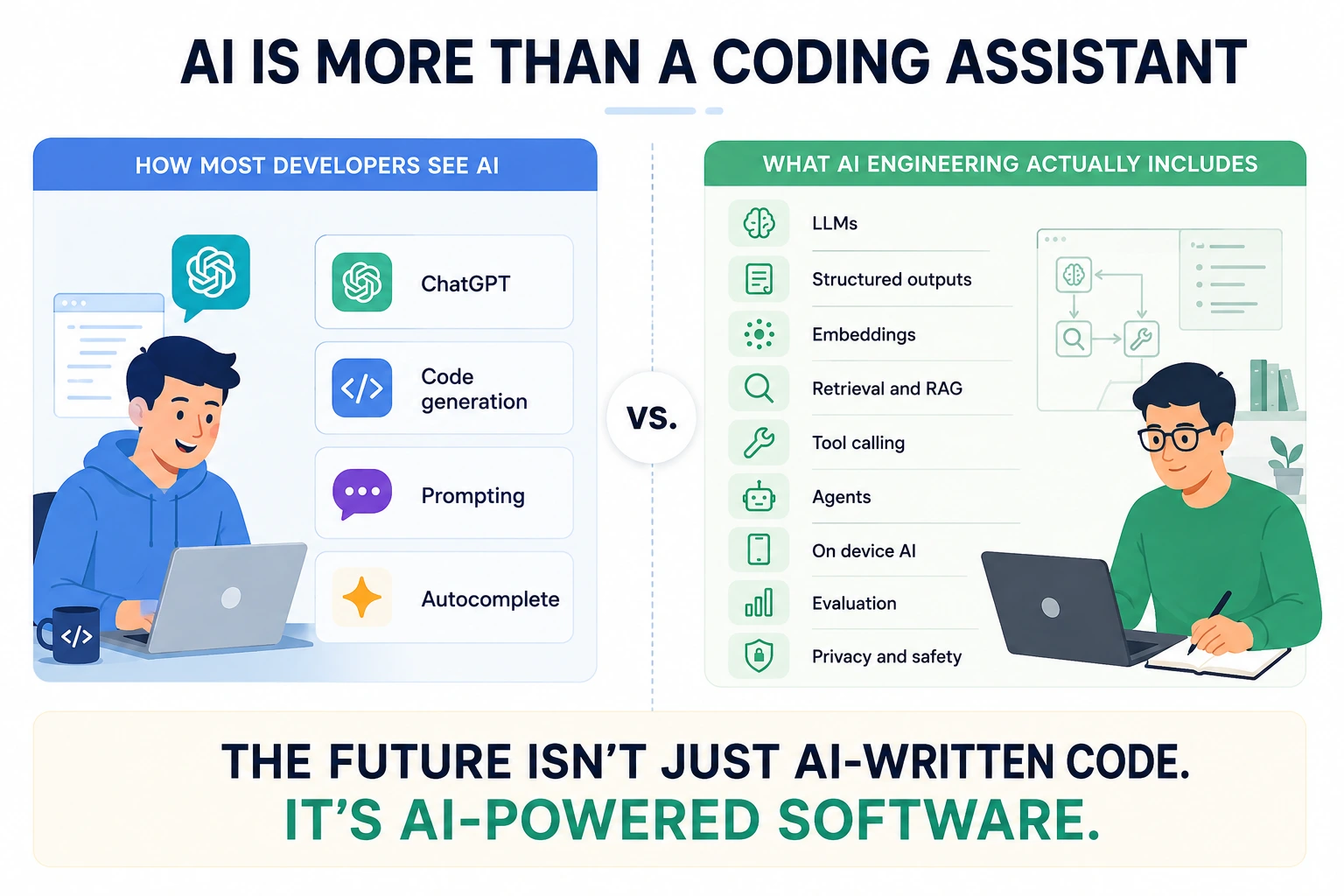
For many developers, the answer would probably be ChatGPT, Claude, Gemini, better prompts, and faster code generation.
That is a useful place to start. But it is not the same as understanding AI.
In this article, when I say AI, I am mainly talking about modern generative AI.
AI Is Much Bigger Than Code Generation
I use AI-assisted coding every day. It has changed how I research problems, explore unfamiliar code, write tests, and move from an idea to a working implementation.
But code generation is only the most visible part of the shift.
Think about it this way. Knowing Android Studio shortcuts does not mean you understand Android. The IDE is only an interface. The real knowledge lies in understanding the lifecycle, state, storage, networking, permissions, performance, and the platform itself.
Prompting is similar. It is one interface for interacting with a model. It is useful, but it is not the whole technology.
The more important change is happening inside the products we build.
Applications can now use foundation models to process natural language, search by meaning instead of exact keywords, work with private data through retrieval, interpret images and audio with multimodal models, and connect natural language requests to real application capabilities through tools.
That changes the role of a mobile engineer.
The question is no longer only, Which AI tool should I use to write code faster?
A better question is, What do I need to understand to build reliable AI-powered software?
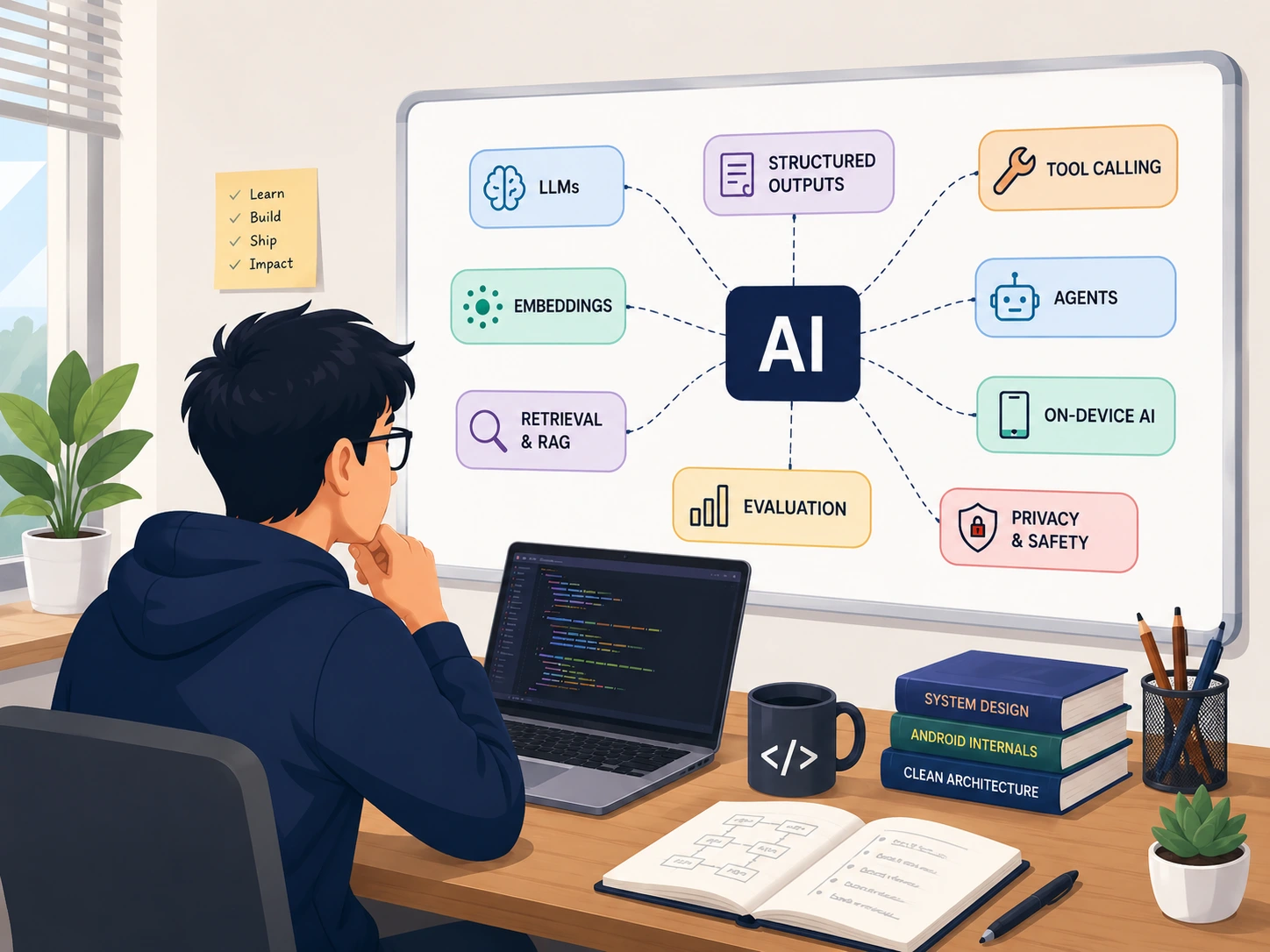
That is where concepts such as embeddings, retrieval, structured output, tool calling, on-device models, agents, and evaluation start to matter.
Not because every mobile engineer needs to become an AI researcher.
Because AI is becoming another layer that modern software is built on.
AI Is Becoming a New Software Layer
The job of a software engineer has never stayed fixed.
The responsibilities of application engineers have kept expanding. We still build interfaces and business logic, but modern apps also require us to think about APIs, persistence, authentication, cloud services, analytics, privacy, performance, and much more.
We did not become specialists in every one of these areas. But we learned enough because our applications started depending on them.
I have started thinking about AI as another layer of application development.
It is no longer limited to a chatbot or a coding assistant. It is becoming part of search, recommendations, automation, document processing, voice, personalization, and the way users interact with software.
Once you see AI as a software layer, the question changes.
You stop asking, Which AI tool should I use?
You start asking, What do I need to understand to build with it?
The AI Concepts Every Mobile Engineer Should Know
Across software development, AI adoption is already high. Stack Overflows latest developer survey found that 84 percent of respondents were using or planning to use AI tools, and 51 percent of professional developers were using them daily.
But there is an interesting gap. More developers distrust the accuracy of AI tools than trust them.
I think that gap matters.
Using AI is quickly becoming normal. Understanding how to build reliable software with AI is a different skill.
So instead of chasing every new model or framework, these are the concepts I think mobile engineers should start understanding.
LLM (Large Language Models)
By now, I'm sure you've used an LLM. But here's the part that still amazes me.
At its core, an LLM is trained to predict the next token based on the context it has already seen. That's it. It almost sounds too simple to be true. So let me add a little more complex definition that is much more accurate,
Then how can it write code, summarize documents, answer questions, translate languages, or even appear to reason?
There is an interesting parallel with humans here. We also anticipate what might come next when we read or have a conversation. But I would not push that comparison too far. Human language is connected to perception, memory, goals, experiences, and continuous interaction with the world. An LLM learns patterns from its training data and the context we give it.
You do not need to know how to train an LLM to start building with one. But you should understand tokens, context windows, probabilistic generation, model limitations, and why a model can sound completely confident while still being wrong. That foundation will make many of the concepts coming next much easier to understand.
Structured Outputs
This is one of those concepts that immediately changes how you think about building with LLMs.
When we think about an LLM, we usually imagine it replying with paragraphs of text. But most applications need data our code can actually work with.
Imagine asking a model to read an invoice. Instead of getting a nicely written summary, your application can define the structure it expects. For example, a JSON object containing the vendor, invoice number, date, amount, and tax.
With APIs that support structured output, you can define a schema for that response. Now your app can deserialize it, validate it, store it in a database, or directly use it in the UI.
One important distinction though. Structured output makes the FORMAT predictable. It does not guarantee that the VALUES are correct. Valid JSON can still contain the wrong invoice amount.
Tool Calling
Sometimes generating an answer is enough. Sometimes your application actually needs to do something.
Maybe the user wants to create a calendar event, search their saved notes, control media playback, or trigger another capability inside your app.
Generating tokens alone cannot perform those actions. The model needs access to external capabilities.
With tool calling, we describe the functions available to the model, including the arguments they expect. Based on the users request, the model can select an appropriate function and generate its arguments. Our application still controls how that function is actually executed.
This becomes especially interesting on Android.
Google is working on AppFunctions, which allows Android apps to expose specific capabilities that trusted agents and assistants can discover and invoke. Google describes AppFunctions as the mobile equivalent of MCP tools.
It is still experimental, and Gemini integration is currently in private preview, so I would not treat it as production ready yet. But the direction is worth paying attention to.
Your app is no longer just a collection of screens a human can navigate. Parts of it can also become capabilities that an AI agent can discover and use.
If you are a mobile engineer, add tool calling to your learning list.
Embeddings
Embeddings are one of those concepts that sound much more complicated than they actually are.
The basic idea is simple. Instead of matching only words, embeddings help software compare meaning.
So a search for knee pain could still find a note that says sore joints after running, even though the words are different.
That makes embeddings useful for semantic search, recommendations, finding related photos or documents, and later for systems like RAG.
As a mobile engineer, you do not need to start with the mathematics. Learn what embeddings are, why similarity search needs them, and where they fit in an AI application. Once you understand that, several other AI concepts start making a lot more sense.
Vector Search
Once you understand embeddings, vector search is the natural next concept.
Embeddings turn content into vectors. Vector search helps you find the vectors that are most similar to each other, which is how semantic search can quickly retrieve content related by meaning.
This is where you will start hearing terms like vector databases, similarity search, metadata filtering, and hybrid search.
You do not need to learn the algorithms behind all of this right away. Just understand how embeddings are stored and searched, because this becomes especially important when you move to the next concept: RAG.
RAG
Once you understand embeddings and retrieval, RAG starts making much more sense.
A model only has the information available from its training and the context you give it. But what if you want it to answer questions using your company documents, personal notes, medical reports, product data, or information that keeps changing?
That is where Retrieval Augmented Generation comes in.
Instead of trying to teach that information to the model, your application first retrieves the most relevant data and gives it to the model as context before it generates the answer.
For a mobile engineer, this is worth understanding because RAG is what makes many useful AI features possible over YOUR data.
You do not need to learn the entire RAG pipeline today. Start by understanding why retrieval is needed, how embeddings fit into it, and why grounding an answer in the right data matters.
On-device AI
This is one area I think mobile engineers should pay special attention to.
Not every AI request needs to go to the cloud. Smaller models can now run directly on supported phones, which can reduce latency, work without a network connection, and keep sensitive data on the device. Android already supports on-device generative AI through Gemini Nano and ML Kit GenAI APIs, while Apple exposes its on-device model through the Foundation Models framework.
But running AI on a phone comes with a different set of problems. Memory is limited. Battery matters. Devices have different capabilities. Models need to be smaller, and sometimes the cloud will still be the better choice.
As a mobile engineer, learn when on-device inference makes sense, what the trade-offs are, and how local and cloud models can work together. That is going to be an increasingly important part of mobile architecture.
Agents
Agents are another term you are going to hear everywhere.
The simplest way I think about them is this.
A chatbot answers a request. An agent tries to complete a goal.
That might mean deciding what needs to happen, choosing the right tools, checking the result, and continuing with the next step instead of stopping after one response.
This is where LLMs, tool calling, memory, retrieval, and application capabilities start coming together.
For mobile engineers, this is worth learning because apps may increasingly become part of these agentic workflows. Instead of only exposing screens to users, we may also expose capabilities that an agent can discover and use.
You do not need to build a complex autonomous agent today. But you should understand what makes an agent different from a normal LLM request and why the industry is moving in this direction.
Evaluation
This is probably the concept I wish more engineers learned early.
With normal software, we usually know what output we expect for a given input. LLMs are different. The same request can produce different answers, and an answer can sound perfectly convincing while still being wrong.
So you cannot build production AI by testing a few prompts and saying, this looks good.
Evaluation means deciding what good actually means for your feature, creating representative test cases, and measuring whether changes make the system better or worse. Depending on the feature, that might include correctness, groundedness, tool selection, structured output validity, latency, or cost. This is why major AI platforms recommend defining success criteria and evaluations early, not after the product is built.
If prompting helps you build the demo, evaluation tells you whether it is actually ready to ship.
Fine tuning
Fine tuning sounds like something you should learn immediately. I would put it much later.
Fine tuning changes the behavior of a model by training it further on examples for a specific task or domain. It can be extremely useful, but you need good training data and a clear way to evaluate whether it actually improved the model.
As an application engineer, first learn prompting, structured outputs, retrieval, tool calling, and evaluation. Learn fine tuning when you actually reach a problem those approaches cannot solve well enough.
Where This Leaves Us?
These concepts are a good starting point. Once you know what they mean and why they matter, you can start exploring them through real projects and gradually build a much stronger understanding of AI-powered software.
The point is not to become an expert overnight. It is to stop seeing AI as just another tool sitting beside your IDE.
Once you understand LLMs, embeddings, retrieval, tool calling, agents, on-device inference, and evaluation, you start seeing completely different possibilities for the apps you can build.
That is the part I find most exciting.
The next generation of mobile apps will not just display data and respond to taps. They will understand context, work with user data, use tools, and increasingly help users complete real tasks.
And as mobile engineers, we are in a very interesting position. We already understand the device, the platform, the user experience, and the constraints. Adding AI to that skill set could open up an entirely new kind of software for us to build.
Recommended Books to Go Deeper
I've read these myself

Links are affiliate links, so I may earn a small commission if you buy, at no extra cost to you. I've read every book listed here and believe it offers real value for going deeper into this topic.

Worth keeping?
Conversation
Continue the conversation
Share a useful addition, question, or correction through GitHub Discussions.